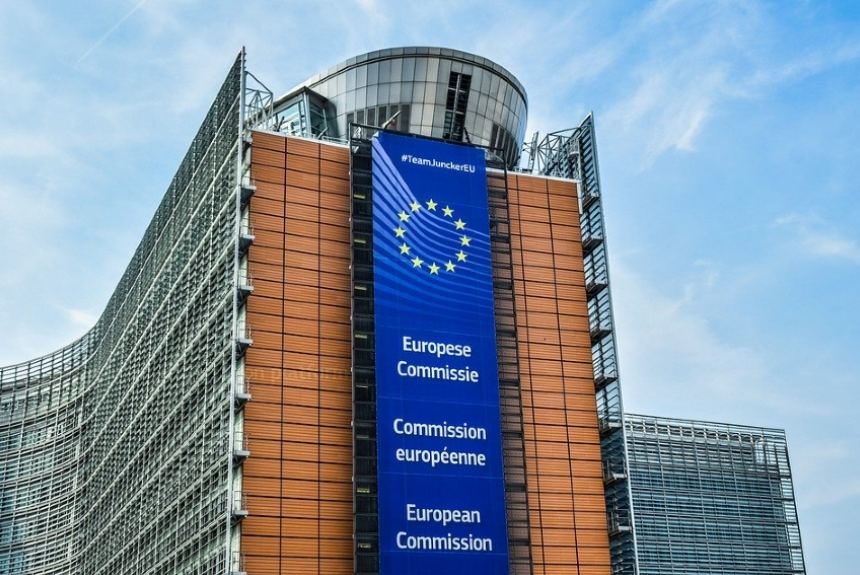
European Commission approves Estonia’s 100% renewable energy plan but warns of shortcomings
Published: 03 October 2025
On 2 October 2025, the European Commission published its comprehensive assessment of Estonia’s updated National Energy and Climate Plan (NECP), recognising the country’s ambitious goal of switching entirely to renewable electricity by 2030 while also drawing attention to significant gaps in reducing greenhouse gas emissions in the transport, buildings and agriculture sectors. This assessment is part of a broader review analysing the progress of all European Union Member States towards the common 2030 climate and energy targets.
European Commission building in Brussels. Source: Climate Adaptation Platform
Estonia has set itself one of Europe’s most ambitious goals—to produce all of its electricity from renewable sources by 2030. This step has earned praise in Brussels and is seen as an important contribution to the green transition across the EU. At the same time, the Commission stresses that greening electricity generation alone is not enough. The report points out that Estonia must make significantly greater efforts to reduce emissions in sectors not covered by the EU Emissions Trading System (ETS) and address the decline in carbon sequestration in forestry. This article analyses the key points of the European Commission’s assessment, examines Estonia’s strengths and weaknesses in the fight against climate change, and considers the next steps on Estonia’s path towards a green future.
The broader context of the European Commission's assessment
National energy and climate plans (NECPs) are key strategic documents for each EU Member State, describing how the energy and climate targets set for 2030 are to be achieved. These targets include reducing greenhouse gas emissions, increasing the share of renewable energy, improving energy efficiency, ensuring energy security, and promoting research and development. The Commission's assessments are an important part of the process, providing countries with feedback and recommendations to ensure the collective achievement of common goals.
The European Union's 2030 climate targets. Source: Euroopa Keskkonnaagentuur
The Commission's report of 2 October 2025 [1] finds that although both Estonia and Slovakia have raised their ambitions compared with their initial plans, both countries still need to make significant efforts. For Estonia, the main concern is the sectors covered by the Effort Sharing Regulation (ESR) — transport, buildings, agriculture and waste management — as well as meeting the targets for the land use, land-use change and forestry (LULUCF) sector. Although Estonia has made progress, concrete and effective measures are needed to close the remaining gaps and ensure the full implementation of the plans.
Estonia's flagship goal: 100% renewable electricity by 2030
Estonia’s most prominent and widely praised goal is to produce 100% of its electricity from renewable sources by 2030. This is one of the most ambitious targets in the entire European Union and demonstrates Estonia’s commitment to radically transforming its energy system. The Commission’s assessment recognises Estonia’s strategy, which relies heavily on the widespread deployment of wind energy supported through public auctions [1].
Offshore wind farm. Source: energynews.pro
In addition to wind energy, other renewable energy sources, such as solar energy and biomass, also play an important role in Estonia’s plan. The Commission’s detailed assessment [2] shows that the share of renewable energy in Estonia’s final energy consumption was 2023. aastal 40,9%, which is a good starting point, but the target for 2030 is 65%. This means that investment and project implementation need to be significantly accelerated in the coming years. A successful transition to renewable electricity is important not only for achieving climate goals, but also for strengthening Estonia’s energy security and independence, especially given the geopolitical situation.
Challenges: Transport, buildings and concerning forestry
Despite progress in renewable energy, Estonia’s climate plan also contains several areas of concern. The biggest challenge is reducing greenhouse gas emissions in sectors that are not part of the emissions trading system. Estonia’s goal is to reduce emissions in these sectors by 2030 by 24% compared with 2005. 2023. aasta andmetel oli vähenemine vaid 9,7%, which means significantly more effective measures are needed to achieve the target [2].
The transport sector is one of the main sources of emissions, and making it greener has proved challenging. The transition to electric vehicles must be accelerated, public transport must be developed, and better conditions must be created for walking and cycling. It is also important to renovate buildings to improve their energy efficiency and to implement more climate-friendly practices in agriculture.
Another major concern is the LULUCF sector. Historically, Estonia’s forests have been important carbon sinks, but this capacity has declined in recent years, partly due to intensive logging. According to the Commission’s assessment, there is a shortfall of Eesti prognoosides süsiniku sidumise osas 0,5 million tonnes of CO2 equivalent against the 2030 target [2]. This is a serious problem that requires swift and decisive action in forestry policy to find a balance between the economic interests of the timber industry and the climate role of forests.
The role of forests in the carbon cycle. Source: ICOS
Energy efficiency, security, and fossil fuel subsidies
Energy efficiency is another area where the Commission expects more from Estonia. Although the plan includes measures to improve the energy efficiency of buildings, the projected energy savings need to be quantified more accurately, and the legal framework must be strengthened to better integrate electricity, heating and cooling networks. This would help optimise energy use and reduce losses.
Regarding energy security, Estonia has taken significant steps by diversifying gas supplies through biomethane and biogas and improving connections with neighboring countries. These measures help reduce dependence on imported fossil fuels and increase the resilience of the energy system.
As a critical observation, the Commission points out that while Estonia has listed its fossil fuel subsidies, it has not presented a specific action plan for phasing them out. The Commission strongly recommends developing such a roadmap and proceeding with the phase-out of solid fossil fuels, particularly oil shale, in accordance with the principles of a just transition [1]. This is an important step toward ensuring the long-term sustainability of the economy and avoiding investments in technologies that have no future.
Increasing the share of renewable energy is a realistic goal. Source: Bankwatch
Summary: An ambitious plan that still needs to be implemented
The European Commission's assessment of Estonia's national energy and climate plan is balanced: it recognises Estonia's bold steps towards renewable energy but also clearly points out problem areas that require swift and decisive action. Estonia has set itself the goal of being at the forefront of the green transition, but achieving this will require more than merely ambitious targets on paper. Concrete, funded, and effectively implemented measures are needed in transport, buildings, agriculture, and forestry.
The need for carbon removal in Estonia. Source: Carbon Gap
The coming years are critical for Estonia. Now that the plans have been updated and assessed, the focus must shift to implementation. This requires political will, investment from the public and private sectors, and broad-based public engagement. Estonia has shown that it can set ambitious goals. Now it is time to prove that we can also achieve them and build a truly green and sustainable future.
International context and comparison
Estonia’s climate plan does not exist in a vacuum, but is part of the broader European Union green transition. Compared with the other Baltic states, Estonia has set the most ambitious goals for renewable energy. Latvia and Lithuania have also committed to increasing the share of renewable energy, but not as radically as Estonia. This positions Estonia as a regional leader in the adoption of green technologies and could give it a significant competitive advantage in the future.
At the European Union level, Estonia's goal of achieving 100% renewable electricity is aligned with the EU's overall strategy to achieve climate neutrality by 2050. The Commission's assessment emphasizes that such ambitious national targets are essential to compensate for slower progress in other Member States. Estonia's success in renewable energy can also inspire other countries and demonstrate that a rapid transition is possible.
Economic impacts and opportunities
The transition to 100% renewable electricity will bring significant economic changes. On the one hand, it requires major investments in the development of wind energy infrastructure, grid connections, and energy storage. On the other hand, it creates new jobs and business opportunities. Estonia has already demonstrated its ability to attract international investors to wind energy projects, bringing both capital and technological expertise to the country.
The gradual phasing out of fossil fuel subsidies, as recommended by the Commission, is also a significant economic challenge. The oil shale industry has been an important part of the Estonian economy, but its role must diminish over time. The principles of a just transition require that workers and communities that have depended on the fossil fuel industry be offered alternative opportunities and support for retraining.
Technological solutions and innovation
Achieving Estonia's climate targets also requires technological innovation. The Commission's recommendation to increase investment in research and development for clean energy technologies is particularly important. Estonia is already known for its digital innovation, and this expertise could also be valuable in developing green technologies.
The development of energy storage technologies is particularly important, as they are necessary to balance fluctuations in wind and solar energy. Smart grid solutions that can efficiently integrate different energy sources and optimize energy distribution are also needed. Estonia could become a testing ground for new technologies that could later also be applied in other countries.
The social dimension and citizen engagement
Achieving climate goals is not only a technological or economic challenge, but also requires broad-based public support and engagement. Citizens need to understand and support changes that affect their daily lives—from the adoption of electric cars to the renovation of buildings. Education and awareness-raising play an important role here.
It is also necessary to ensure that the green transition is socially fair. Rising energy costs must not disproportionately affect lower-income households. It is therefore necessary to consider support schemes and measures that help all members of society benefit from the green transition.
The role of local governments is also critical. They are the ones who implement many climate measures in practice—from developing public transport to improving the energy efficiency of buildings. The Commission’s assessment emphasizes the need to strengthen cooperation between different levels of government.
Next steps and monitoring
The European Commission's assessment is not the end point, but rather the beginning of a new phase. The Commission will continue to work closely with Estonia to help address the identified shortcomings and ensure the effective implementation of the plans. Regular monitoring and reporting are important, allowing corrections to be made and measures to be adapted to changing conditions where necessary.
The Commission has pledged to assess whether additional measures are needed at the EU level to ensure that collective targets are achieved, particularly in the areas of renewable energy and energy efficiency. This could mean new directives, funding schemes or technical assistance programmes.
For Estonia, this means that the country must be prepared to react and adapt quickly. Achieving climate targets is a dynamic process that requires continuous learning, adaptation, and improvement. The Commission's assessment provides the necessary roadmap and guidelines, but the actual work is only beginning.
To provide the best experiences, we use technologies like cookies to store and/or access device information. Consenting to these technologies will allow us to process data such as browsing behavior or unique IDs on this site. Not consenting or withdrawing consent, may adversely affect certain features and functions.
Functional
Always active
The technical storage or access is strictly necessary for the legitimate purpose of enabling the use of a specific service explicitly requested by the subscriber or user, or for the sole purpose of carrying out the transmission of a communication over an electronic communications network.
Preferences
The technical storage or access is necessary for the legitimate purpose of storing preferences that are not requested by the subscriber or user.
Statistics
The technical storage or access that is used exclusively for statistical purposes.The technical storage or access that is used exclusively for anonymous statistical purposes. Without a subpoena, voluntary compliance on the part of your Internet Service Provider, or additional records from a third party, information stored or retrieved for this purpose alone cannot usually be used to identify you.
Marketing
The technical storage or access is required to create user profiles to send advertising, or to track the user on a website or across several websites for similar marketing purposes.