
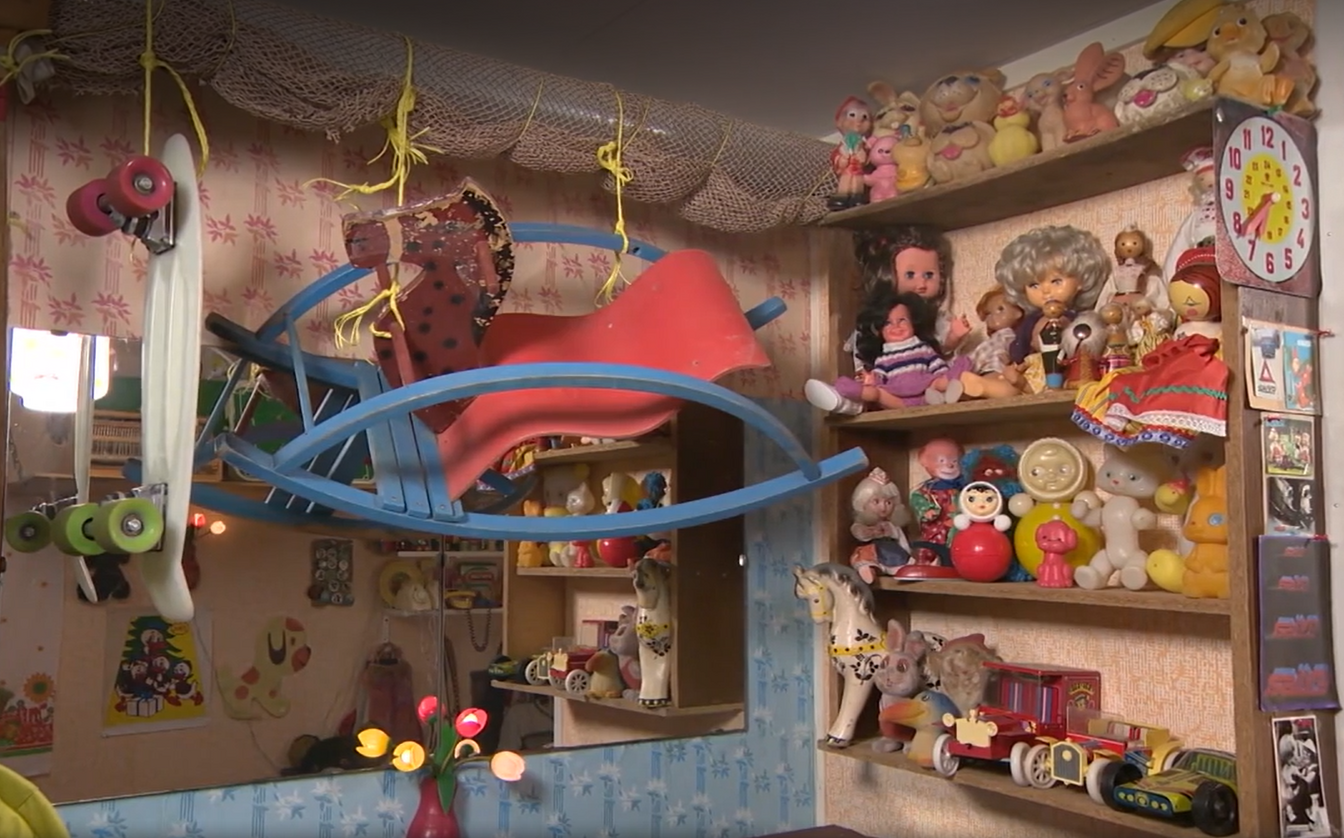
A 1980s-style retro apartment museum opened in a construction site cabin in Lääne-Virumaa
26 November 2025
Image: ERR
Near Rakke in Lääne-Virumaa, one woman’s personal remembrance project has become a unique small museum: a construction cabin converted into a retro apartment in the style of the 1980s. At the heart of this story is Merike Õun – a woman who decided to give new life to items found in the depths of a cupboard and offer local seniors and visitors the chance to take a small step back in time. ERR+1
Today, a modest portable cabin stands in the yard behind her home. Upon stepping through its door, visitors quickly forget that they are in the 21st century. The curtains, wallpaper, furniture, clothing and toys create a complete picture of a Soviet-era Estonian home—just like the one many remember from their childhood.
An idea born during a major cupboard clean-out
The story of the Retrokorter-muuseum began in a surprisingly mundane way. A few years ago, Merike Õun went on sick leave and decided that the time had finally come to do what her mother had long been asking her to do: thoroughly tidy up the cupboards at home. ERR
Thus, one after another, the following ended up on the table:
-
dresses and costumes that “once seemed too precious to throw away”;
-
children’s clothes and small sweaters;
-
Soviet-era toys that were kept “behind a cabinet or behind glass”;
-
cups, dinnerware sets, doilies, curtains, and other home furnishings from the 1970s–1980s.
The more the woman found, the clearer it became that there were too many things to simply put them in a bag and take them to the landfill. Their emotional value was greater than the benefit of gaining more cupboard space.
It was at that very moment that the idea arose: why not create a small retro home in the yard – a place not only to keep these things, but also to show them to others. The plan was not to create a traditional museum with display cases and signs, but a living, authentic apartment that you can enter, sit down on the sofa, and briefly forget what year it is.
A construction site cabin was turned into a small 1980s apartment
A suitable space for the retro home was found quite nearby—it was an old construction site cabin, which nowadays is often simply called a container. These are usually seen beside construction sites, not furnished as homes. ERR+1
Merike decided that this modest portable cabin would become an “apartment in a box”:
-
the walls received new coverings and interior design reminiscent of 1980s wallpaper and colour schemes;
-
the floor was covered with rugs that had previously been kept at home because they were “too good to throw away”;
-
light fixtures were chosen that resemble Soviet-era chandeliers and wall lamps;
-
furniture was arranged as it typically was in three-room or two-room apartments at the time.
It was important that the space should not look like a set, but like a home that was genuinely lived in, with a logical layout, real “everyday living logic,” and warmth.
A children’s room, a bedroom and wardrobes full of dresses
The “layout” of the retro apartment is simple but well thought out. The children’s room is connected to the bedroom – just as it often was in smaller apartments. ERR
The apartment features:
-
children's room, with a play area with dolls, board games, books, and other things reminiscent of children's everyday life at the time;
-
bedroom, with a large bed, wall unit, wardrobe and mirror;
-
wardrobe, which conceals a surprisingly impressive collection: dresses, suits, hats, shoes – many of them barely worn.
Some of the toys are completely new—they were kept behind glass for years, “for better times.” Now they are part of the exhibit, showing what a child’s dream doll or car looked like in the 1980s.
Merike emphasizes that preserving the story behind each item is important to her. Some dresses are tied to a specific memory—a wedding, an anniversary, or an important work meeting. The toys are reminders of birthdays and graduation gifts. Visitors also enjoy hearing where each item came from—this is how a dialogue between “things and people” is born.
A personal childhood and work with the elderly came together
Merike Õun works with elderly people on a daily basis, and it was this experience that made her feel that the retro apartment could bring joy to many of those in her care. ERR
Many older people are happy to talk about their youth, but usually they can only rely on their memories. The retro apartment museum offers an opportunity to go back with them to a time when:
-
the wall unit was the centrepiece of every self-respecting home;
-
a black-and-white or early color television brought the whole family together around it in the evenings;
-
the wardrobe contained “Sunday dresses” and “work clothes”, with a clear distinction between them;
-
toys were often kept “at best” on a shelf rather than on the floor.
Merike says that many elderly people find such an environment surprisingly moving—they recognize familiar patterns, dishes, and styles. Sometimes visitors have said, “I had exactly the same lamp” or “we had curtains just like those hanging in our kitchen.” This immediately creates common ground and warmth.
Small retro events for seniors and guests
In addition to being open daily (by arrangement), Merike Õun's greater dream is to hold small themed events in the retro apartment. ERR
Her plans include:
-
reminiscence afternoons for seniors, where they can drink tea together, listen to music from the 1980s, and reminisce about everyday life;
-
family visits, where grandparents can show their grandchildren “how we lived in our day”;
-
small themed celebrations, such as International Women’s Day or New Year’s Eve in retro style;
-
educational visits for schoolchildren, where history can be explained through real objects, not just textbook pictures.
Such events help bridge the generational gap—younger people can ask questions, while older people can share their stories. In this way, the retro apartment museum becomes not only an attraction but also a community meeting place.
A retro kitchen as the next step
The current apartment museum focuses mainly on the living quarters and sleeping area, but Merike does not plan to stop there. Her next goal is to build a separate retro kitchen next to the existing site cabin, which would create an even more complete picture of life at the time. ERR+1
The vision for the retro kitchen includes:
-
a wood-burning stove or a typical electric stove on which many people learned to make their first soups and roasts;
-
enamelware, glass sugar bowls, and “coffee culture”;
-
lace curtains and tablecloths that many people still recognise;
-
kitchen cupboards where you may find Soviet-era packaging, tin cans and other items that are no longer found on store shelves.
Such a kitchen would not be merely decorative—the idea is that small groups could cook together there, exchange recipes, and recreate some old favorite dishes. In this way, the past becomes a physical experience: smells, flavors, and sounds merge with the visual setting.
Why are such small museums important today?
Although Estonia’s museum network is diverse and professional, small, privately initiated museums like this have their own special role. A retro apartment museum near Rakke:
-
preserves the story of everyday life at the micro level, which large museums may not present in such detail;
-
shows the Soviet era through a domestic lens, rather than only a political or economic one;
-
creates a safe environment for talking about memories, which has therapeutic value for many elderly people;
-
brings life to a small town and rural area, giving both locals and passers-by a reason to visit.
What is particularly fascinating about places like this is that every item in the room comes from real life. This is not a stage set, but things that have been used and have belonged in the homes of “real families.” This gives the museum a warm, slightly intimate character.
An experience for locals and visitors alike
Lääne-Virumaa is known for its beautiful nature, small settlements, and quiet pace of life. The retro apartment museum adds a distinctive cultural destination that is well suited as:
-
part of a family day out – especially if the family includes different generations;
-
a brief stopover on the way to Tartu or Tallinn, for those looking for something that is not a “typical tourist attraction”;
-
part of a community event, where it can be combined, for example, with a local choir concert, fair or charity event.
Although it is not a large, official museum, its impact on visitors can be surprisingly profound. For many people, it is precisely everyday nostalgia – a familiar wall hanging, an old radio, a dress sewn by their mother – that is much more meaningful than a monument or memorial plaque.
How can you find the retro apartment museum?
Since this is a private courtyard museum near Rakke, it has neither a conventional ticket office nor fixed daily opening hours. According to an ERR story, the retro apartment is primarily Merike Õun's passion project, opening its doors to visitors by arrangement and especially when there is an occasion to organise joint retro events. ERR
Practical advice for those interested:
-
follow local channels and community information (Rakke area groups, the municipal newspaper, and event calendars);
-
if you have an opportunity to visit with a group, take it – the experience is most immediate in a smaller group;
-
communicate politely and respectfully, bearing in mind that this is someone’s home and yard, not a large state institution.
Inspiration for everyone whose home is full of “hidden treasures”
Merike Õun's story resonates with many people: it is quite likely that nearly every Estonian home has a cupboard or attic where childhood toys, grandmother's dinnerware sets, or cherished clothes that have not been worn for a long time are still kept.
The retro apartment museum reminds us that:
-
old things do not necessarily have to end up in a landfill;
-
the emotional value of objects can be shared – they can become part of the community’s story;
-
small private projects can give a region an entirely new attraction.
If someone is planning to create their own little nostalgia corner, craft studio, or home museum, in addition to furnishing it, they should also consider how to spread the word about it. In Estonia, people increasingly search for services and experiences online – and local portals play an important role in making such initiatives visible. One option is to use dedicated platforms for advertising services and small ventures, such as Easyfind, where you can add photos and videos, contact details, and a detailed description of your experience. This way, the retro story can reach those who might otherwise never visit the Rakke area.
A small apartment, a big story
A construction cabin standing in a small courtyard in Lääne-Viru County is a genuine example of how a personal memory and objects found while clearing out a cupboard can grow into something much bigger. The retro apartment museum is not merely nostalgic decoration. It is:
-
a place where people can tell their story;
-
a classroom for the younger generation;
-
a safe space for emotions, recollections and discussions;
-
a small but impactful glimpse into the history of everyday life in Estonia.
With her apartment museum, Merike Õun has shown that even an old site cabin can become an experience that prompts visitors, as they walk out the door, to ask themselves: what might our own cupboards contain that we have yet to appreciate?