From Roomba to Bankruptcy: iRobot's Painful Business Lesson and Rise Under Chinese Control
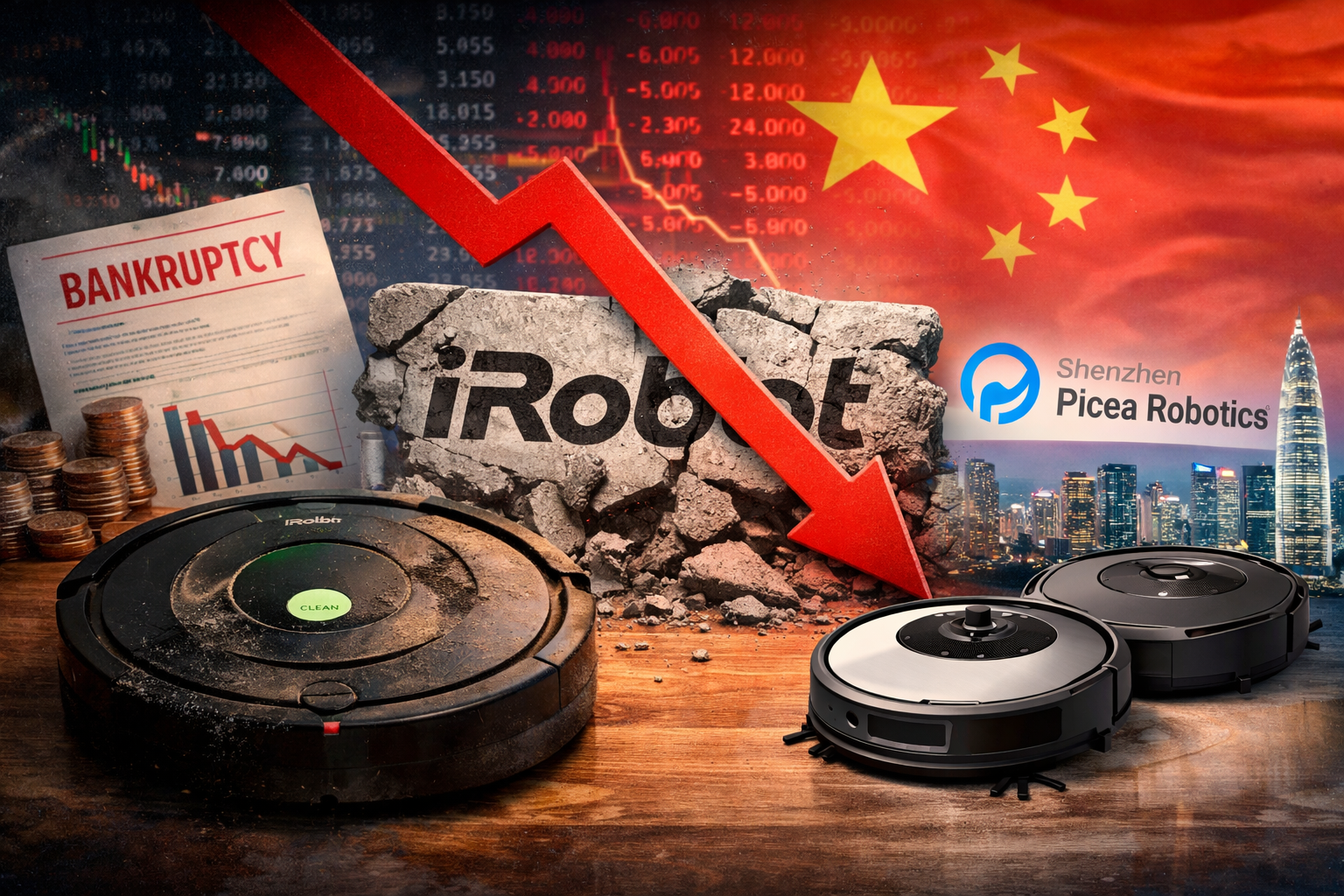
A symbol of American innovation and a former pioneer of home robotics, iRobot, the creator of the world-famous Roomba robot vacuum cleaner, has reached the end of its history as a public company. The company announced bankruptcy and a transition to the control of Chinese manufacturer Shenzhen Picea Robotics. This event is not merely the failure of a single company, but an important case study and cautionary lesson for the entire business world, revealing the harsh truth about today's global competition, supply chain complexity, and the race for innovation.
iRobot was once the undisputed leader in its field. Founded in 1990 by three scientists from Massachusettsi Tehnoloogiainstituut (MIT), the company launched Roomba in 2002, forever changing our understanding of home cleaning and creating an entirely new product category. The company's success culminated in 2021. year, reaching mil selle aastakäive ulatus peaaegu 1,6 billion dollars. But only a few years later, this same pioneer faced financial collapse. What went wrong?
An Avalanche of Critical Errors and Challenges
iRobot's decline was not caused by a single mistake, but by a combination of several interconnected factors that formed a devastating perfect storm. An analysis of the chain of events reveals three main areas: the failure of a strategic deal, the advance of Chinese competitors, and internal financial problems.
Failed Amazon Deal: The Loss of a Vital Lifeline
In 2022, a glimmer of hope seemed to shine for iRobot when e-commerce giant Amazon teatas plaanist omandada ettevõte 1,7 billion dollars. This deal would have provided iRobot with a much-needed financial injection for investment, product development, and remaining competitive. Unfortunately, the plan never came to fruition. Regulators in both the European Union and the United States expressed serious concerns about the deal's anti-competitive impact, fearing that Amazon could favor iRobot products on its platform and push out other manufacturers.
In January 2024, the companies announced the cancellation of the deal. The consequences were devastating for iRobot. The company was forced to lay off 31% of its employees, and its founder and long-time CEO Colin Angle stepped down. Angle himself called the blocking of the deal tragic, arguing that it did a disservice to the entire American home robotics industry.
“The tragedy of blocking this deal is that we did it to ourselves,” Angle commented. “And the end result, which I contend was done quite deliberately, was putting the consumer robotics industry in a box, wrapping it in gift paper, and handing it over to someone else.”
The Chinese “Cage Match”: The Battle iRobot Could Not Win
However, the most significant external pressure proved to be the aggressive and rapid rise of Chinese competitors. Brands such as Roborock, Ecovacs and Dreame offered not just cheaper alternatives, but often technologically more advanced and functional solutions. According to market research firm IDC, in the second quarter of 2025. the five largest Chinese manufacturers held nearly 70% of the global robot vacuum cleaner market, leaving iRobot in sixth place.
Global Robot Vacuum Cleaner Market Share (Q1 2025)
Location
Company
Country of origin
Market share
1
Roborock
China
19.3%
2
Ecovacs
China
13.6%
3
Dreame
China
11.3%
4-5
Xiaomi, Narwal
China
~18%
6
iRobot
USA
~6-8%
Source: IDC, 2025
Hiina brändide edu taga on mitu tegurit. Esiteks, nad investeerisid massiivselt teadus- ja arendustegevusse, tuues turule uuendusi nagu täiustatud kaardistamine, isetühjenevad ja -pesevad dokid ning tehisintellektil põhinev takistuste vältimine palju kiiremini kui iRobot. Teiseks, nad kasutasid ära e-kaubanduse platvorme, et kiiresti kasvatada oma bränditeadlikkust ja müüki üle maailma. Kolmandaks, ja mis kõige olulisem, nad said kasu Hiina valitsuse protektsionistlikust poliitikast, mis andis neile tohutu ja kaitstud koduturu, kus oma tooteid arendada ja täiustada enne globaalsele areenile sisenemist.
Colin Angle described this competition as a “cage match” (cage match), where the playing field was not level. iRobot lost market share even in its home market, as consumers preferred competitors that offered better value for money.
Internal Financial Problems and High Costs
In addition to external threats, iRobot was also plagued by internal problems. The company's cost structure was high. Manufacturing outside China, large investments in research and development that did not generate returns quickly enough, and tariffs imposed by the United States on goods manufactured abroad drained the company's financial reserves. The decline in sales since the 2021 peak exacerbated the problems further, ultimately leaving the company with a debt burden of nearly 190 million dollars.
Bankruptcy and a New Beginning Under the Chinese Flag
1.On 2025 December, iRobot announced that it had filed for Chapter 11 bankruptcy protection, which allows the company to restructure under court supervision. At the same time, it was announced that the company would be acquired by its main manufacturing partner and lender, the Chinese company Shenzhen Picea Robotics. This is a symbolic moment in which the factory that once produced devices for an American brand now becomes the owner of that brand.
The transaction, completed in January 2026, turns iRobot into a privately held company. The new CEO, Gary Cohen, has confirmed that the company will continue its normal operations and that customers will be assured continuity of products, the app, and support.
Business Lessons from iRobot's Downfall
The iRobot case offers several valuable lessons for every company operating in today's rapidly changing world:
1.Innovation does not guarantee lasting success. Even market creators and pioneers can lose their position if they fail to respond quickly enough to new threats and market changes. Continuous and rapid product development is critical for survival.
2.Underestimating the competition is deadly. iRobot underestimated the speed, technological capabilities, and aggressiveness of its Chinese competitors. In today's world, a good product is no longer enough; companies need to understand the entire global competitive landscape.
3.Supply chain risks are real. Dependence on a single manufacturing partner or region can prove to be a strategic vulnerability. The takeover by Picea Robotics illustrates how the balance of power within a supply chain can change dramatically.
4.Regulations can change the game. The failure of the Amazon deal shows how decisions by governments and regulators can directly affect a company's fate, even when the intentions are good.
5.Adapt or fade away. The market dictates the pace of innovation and pricing. Companies that are unable to adapt to the market's new rules are destined to lose, regardless of their former glory.
The story of iRobot is a sad reminder that in the world of technology, yesterday's achievements carry no weight tomorrow. It is a story of the fading American dream and the advance of a new, China-centric global economic order. The Roomba revolution is over, and from its ashes rises a new order led by those who are faster, hungrier, and more ruthless.
Reusable beeswax wrap – a natural alternative to plastic wrap
23.90€
Tallinn, Eesti
Manage Consent
To provide the best experiences, we use technologies like cookies to store and/or access device information. Consenting to these technologies will allow us to process data such as browsing behavior or unique IDs on this site. Not consenting or withdrawing consent, may adversely affect certain features and functions.
Functional
Always active
The technical storage or access is strictly necessary for the legitimate purpose of enabling the use of a specific service explicitly requested by the subscriber or user, or for the sole purpose of carrying out the transmission of a communication over an electronic communications network.
Preferences
The technical storage or access is necessary for the legitimate purpose of storing preferences that are not requested by the subscriber or user.
Statistics
The technical storage or access that is used exclusively for statistical purposes.The technical storage or access that is used exclusively for anonymous statistical purposes. Without a subpoena, voluntary compliance on the part of your Internet Service Provider, or additional records from a third party, information stored or retrieved for this purpose alone cannot usually be used to identify you.
Marketing
The technical storage or access is required to create user profiles to send advertising, or to track the user on a website or across several websites for similar marketing purposes.